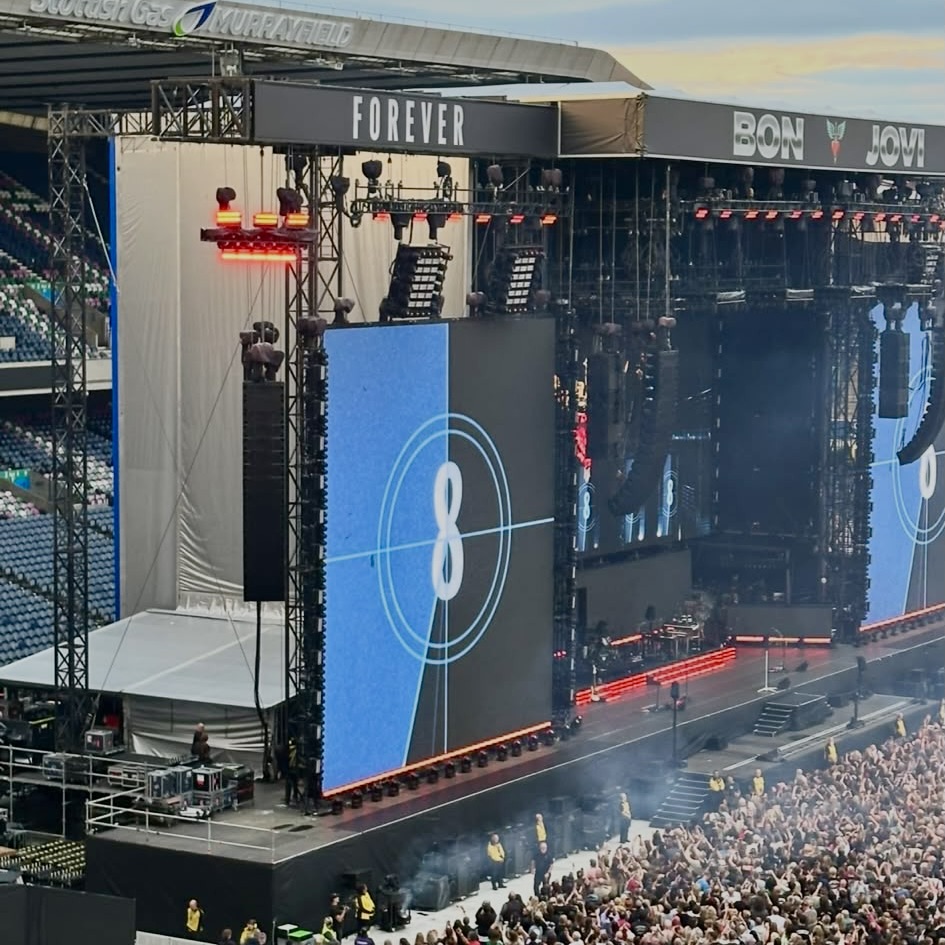
I went to see Bon Jovi at Murrayfield recently.
The concert was brilliant.
But I also spotted three things that any presenter could learn from.
Lesson One: Give Them Time to Join In
Countdowns are used a lot by presenters.
The timer for Bon Jovi started at 25 seconds.
That gave everyone in the stadium enough time to realise what was happening and join in.
By the final 10 seconds, everyone was shouting out the countdown.
For a small conference, you probably don’t need 25 seconds.
But be aware that it can take longer than you think for people to get involved.
I have seen plenty of speakers use:
“3, 2, 1…”
…only for half the audience to realise too late what they were supposed to be doing.
If you want your audience to join in, give them enough time to respond.
Lesson Two: Show Them You’ve Thought About Where You Are
The concert was in Scotland.
So, two members of the band, Phil X and Everett Bradley, wore kilts.
It wasn’t immediately obvious.
But later, the camera zoomed in and the kilts appeared on the giant screen.
The audience loved it.
For a presentation, it doesn’t need to be a grand gesture.
In fact, subtle can be better.
Think about the organisation.
The venue.
The city.
The event.
Show your audience that you’ve thought about where you are.
Lesson Three: Build Up to the Big Moment
About 15 minutes into the gig, things were going along nicely.
Jon Bon Jovi picked up the mic and yelled:
“Let’s party like it’s 1999.”
The crowd cheered.
Then:
“Let’s party like it’s 1989.”
The crowd cheered a little louder.
Finally:
“No, let’s party like it’s 1986.”
The crowd roared.
And then came the opening chords of You Give Love a Bad Name.
What a smart way to introduce one of their most iconic songs.
You can use exactly the same principle in a presentation.
Announce something good.
Upgrade it to something better.
Then knock it out of the park with your third statement.
What Presenters Can Learn from Bon Jovi
These three presentation lessons from Bon Jovi all have something in common.
They put the audience at the centre of the experience.
Give people enough time to participate.
Show them you’ve thought about where you are.
And when you have something big to reveal, don’t simply announce it.
Build them towards it.
Small details can make a big difference to how an audience responds.