I was running a training seminar in Hong Kong recently when someone asked an excellent question about eye contact with a large audience.
“How do I make eye contact with several hundred people in my audience?”
They were preparing to speak at a Town Hall meeting and were concerned about connecting with such a large crowd.
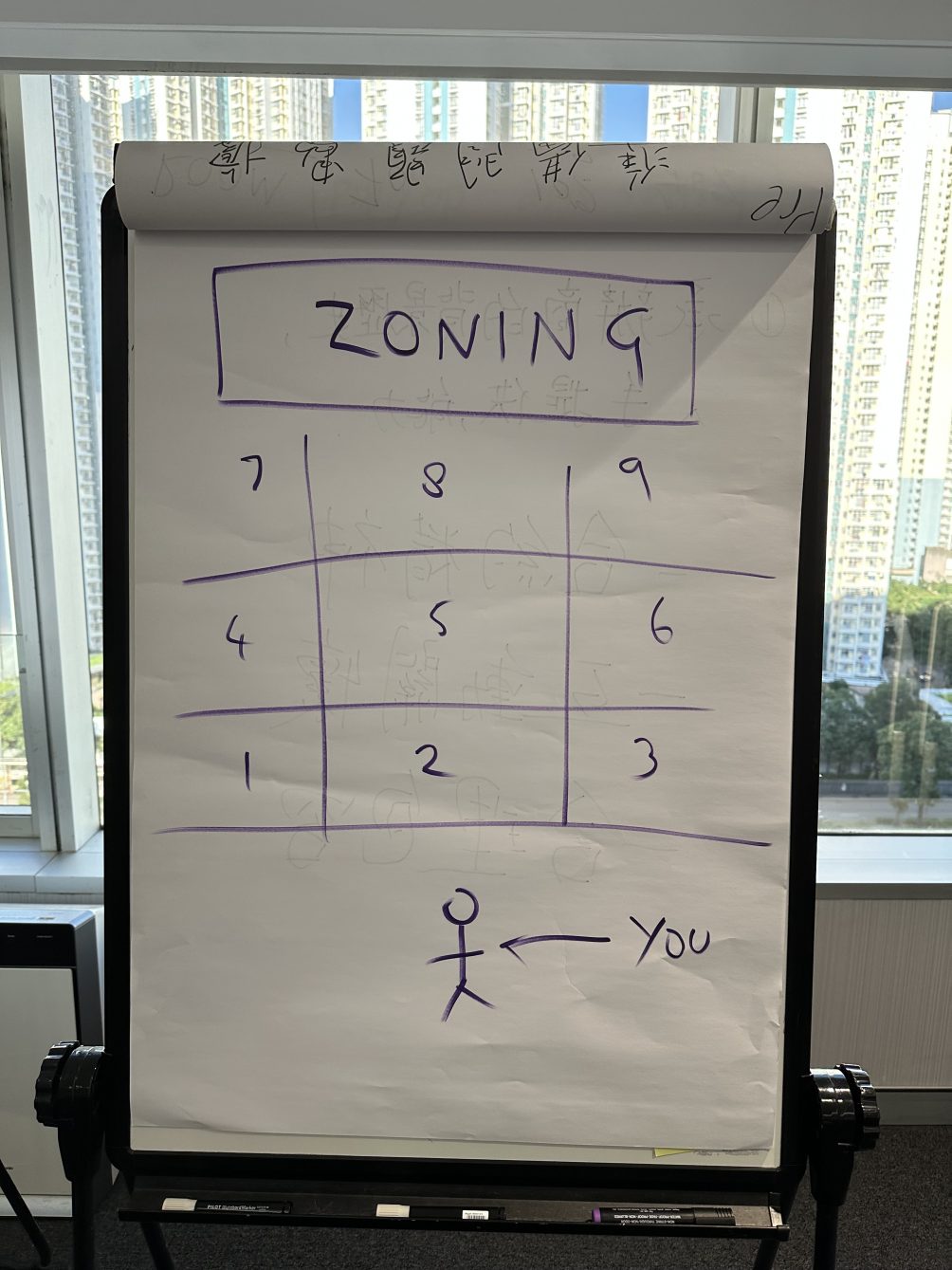
Part of my answer was to explain a technique known as Zoning, which is one of the simplest ways to improve eye contact with a large audience.
How Zoning Improves Eye Contact with a Large Audience?
Imagine you are speaking to a large audience.
You cannot realistically make individual eye contact with every person.
In fact, it would look rather odd if you tried
Instead, divide the audience into zones.
A useful starting point is a 3 x 3 grid:
- Three horizontal sections
- Three vertical sections
This creates nine separate zones.
The exact number can vary depending on the room layout.
How the Technique Works
During your presentation, make a conscious effort to look at each zone rather than each individual person.
This simple approach makes eye contact with a large audience feel much more natural and manageable.
Most audience members within that zone will feel that you are looking at them directly.
They key is to give each zone a fair share of your attention.
Why it Works
People want to feel acknowledged.
When speakers focus on zones, the audience experiences a stronger sense of connection without the speaker appearing unnatural.
Watch a pop star performing in a large arena.
When they look towards a section of the crowd, people in that area feel personally connected.
The same principle applies to presentations.
Conclusion
Zoning is simple.
It is practical.
And it is easy to implement.
If you regularly speak to larger audiences, improving eye contact with a large audience is a skill worth developing, and Zoning is a technique worth adding to your toolkit.
If you found this useful, you may also enjoy reading how a weak start can cost you your audience and how to prevent it.